
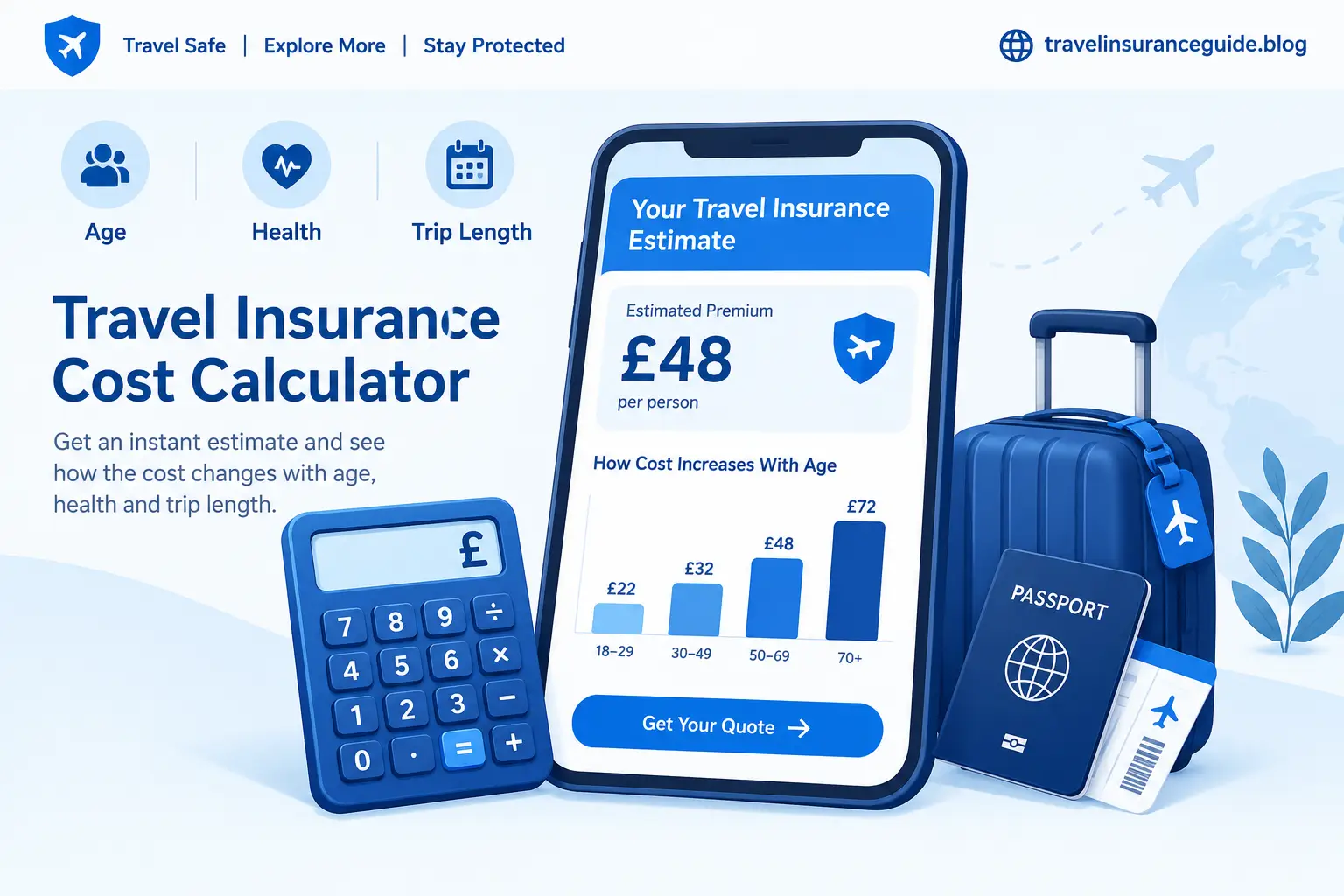
Planning a trip and not sure what your travel insurance might cost? Use our free travel insurance cost calculator below to get an instant estimate based on your age, health profile and trip length.
✈️ Travel Insurance Cost Estimator
Estimate your daily and total insurance costs instantly based on your age and health profile.
How to Use This Travel Insurance Cost Calculator
Using our online estimator is very simple. To get an accurate calculation for your upcoming holiday coverage, just follow these three quick steps:
- Select Your Age Group: Click the first dropdown menu and choose the option that matches your biological age bracket.
- Choose Medical Conditions: Declare whether you have no health issues, mild conditions (like high blood pressure), or chronic serious illnesses.
- Enter Trip Duration: Type the exact number of days you will be away from home in the input box, then click the blue "Calculate Estimated Cost" button.
Key Factors That Affect Travel Insurance Premiums
Underwriters and insurance companies do not offer flat rates. They calculate your daily policy prices based on specific personal risk factors:
- Age Profiling: Older travellers, especially senior citizens over the ages of 75, 80, or 90, pay higher average daily rates because medical risks scale upward with age.
- Health History: Pre-existing health conditions (such as diabetes, heart disease, or history of stroke) require extra financial cover, which increases the total contract premium.
- Trip Length: Travel insurance costs are heavily dependent on time. Since you are charged on a per-day base rate, a longer vacation will naturally cost more total money than a short multi-trip holiday.
Travel Insurance Cost Calculator: Sample Examples by Age Group
To help you understand what these numbers actually mean, here's how a typical trip might look across different age brackets. These are illustrative examples only your actual quote will depend on your specific health declarations, destination and chosen provider.
A traveller aged 18-35 with no medical conditions taking a 10-day European trip typically sees the lowest daily rate. This is because younger travellers carry the least statistical medical risk. Similarly, someone in the 56-70 bracket with mild conditions like high blood pressure will usually see a moderate increase. This reflects the slightly higher likelihood of a medical claim. However, for the 71-80 and 81+ brackets, especially with chronic conditions such as diabetes or a heart condition, daily rates climb further still. Overall, this pattern is standard across the UK travel insurance market, not specific to any one provider.
The key pattern worth remembering: age and health conditions don't just add together, they compound. As a result, a younger traveller with a serious condition may pay a similar premium to an older traveller with no conditions at all. This is exactly why the calculator above asks for both, rather than age alone.
Tips to Lower Your Travel Insurance Premium
A few practical steps can genuinely reduce what you pay, without cutting corners on cover:
- Book earlier rather than later. Some insurers price annual and single-trip policies more favourably when purchased well ahead of departure, particularly for pre-existing conditions.
- Compare specialist providers, not just mainstream ones. Insurers that focus specifically on older travellers or specific conditions (such as heart conditions) often price more competitively for that exact risk profile than a general insurer would.
- Choose the right cover type for your travel pattern. If you travel more than twice a year, an annual multi-trip policy is often cheaper overall than repeated single-trip purchases — see our guide on yearly travel insurance for over 75s for how this works.
- Avoid over-insuring. Worldwide cover including the USA costs significantly more than Europe-only cover only pay for the geographical range you actually need.
- Never under-declare a condition to save money. A lower premium from non-disclosure isn't a saving it's a claim that won't get paid.
Why Travel Insurance Costs Vary Between Insurers
Two insurers can quote very different prices for the exact same traveller and trip, and this isn't random. Each insurer builds its own underwriting model, weighing age, medical history, destination and trip length slightly differently. A provider that specialises in senior travellers such as those covering over 70s, over 80s or over 90s often prices more accurately for older age brackets than a general insurer that treats every age group the same way.
This is exactly why comparing quotes matters more than relying on a single estimate. The calculator above gives you a starting benchmark; an actual quote from two or three providers will show you where the real savings are.
Frequently Asked Questions
Premium scaling is directly linked to medical risks. Historic statistical data indicates a higher frequency of medical claims, inpatient hospital admissions, and specialized critical care needs for elderly travelers over the age of 75.
No. Non-disclosure of medical conditions completely invalidates your travel policy. Failing to declare your health history means the provider can legally reject your medical claims, leaving you responsible for expensive overseas hospital bills.
Generally yes, as underwriters apply a per-day risk rate to your profile. However, specialized long-stay or gap-year single-trip policies extending past 90 consecutive days often trigger bulk discount pricing structures from mainstream insurance providers.
Note: This is a rough estimation based on historical market trends. Actual quotes vary depending on medical screening and destination risk.
About the Author

Rahib Naqvi researches and writes about travel insurance for UK and international travellers, with a focus on senior cover, pre-existing medical conditions, and destination-specific policies.