
Travel insurance with a heart condition typically costs 20% to 200% more than standard policies, depending on age, destination, medical stability, and recent treatment. For many travelers, single-trip policies range from moderate to high premiums, while annual cover can be significantly more.
The exact price depends on cardiovascular risk, not just the diagnosis itself.
Below, you’ll find realistic cost ranges, what affects pricing, how underwriting works, and how to avoid paying more than necessary.
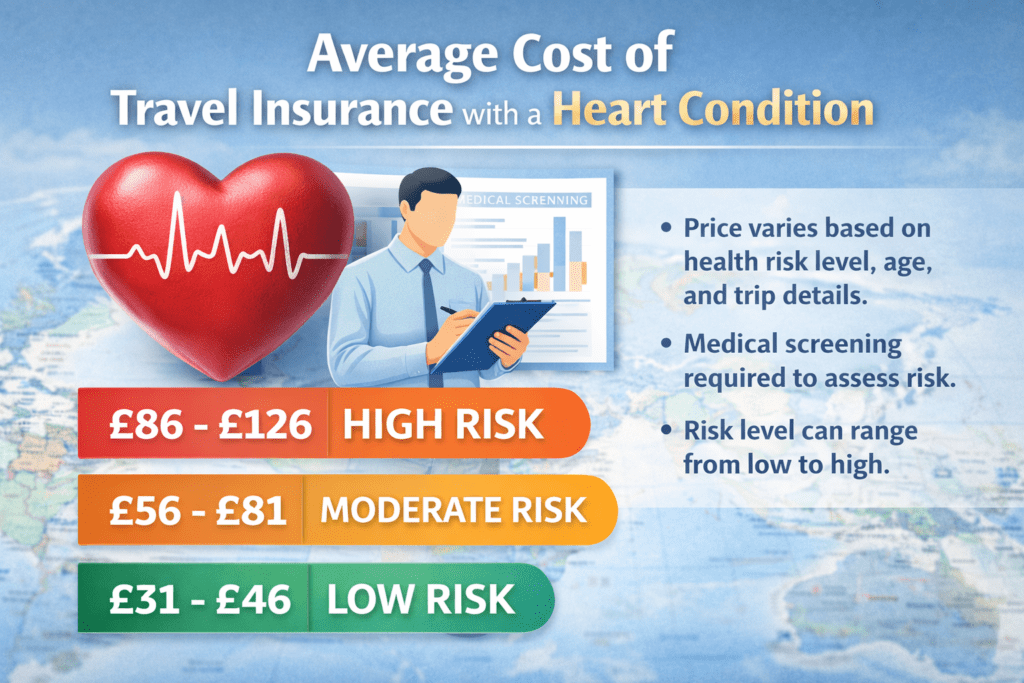
Average Cost of Travel Insurance with a Heart Condition
While prices vary globally, here’s a general breakdown based on common scenarios:
| Scenario | Estimated Cost Range |
|---|---|
| Age 40–55, stable angina, Europe (1 week) | Moderate premium |
| Age 60+, atrial fibrillation, Europe | Moderate–High premium |
| Age 60+, previous myocardial infarction, USA | High premium |
| Age 70+, coronary artery disease, worldwide incl. USA | Very high premium |
| Cruise insurance with cardiac history | Higher than land-based travel |
Real Example: How Much a Heart Condition Adds to Your Premium
To put this in perspective, here’s a real comparison based on a 50-year-old traveller taking a one-week trip to Spain:
| Traveller Profile | Average Premium | % Increase vs No Conditions |
| No pre-existing conditions (baseline) | £24.50 | — |
| Mild asthma (inhaler, no hospital visits) | £29.00 | +18% |
| Heart condition (Atrial Fibrillation, on medication) | £92.00 | +275% |
Based on 2026 UK market data for a 50-year-old traveller to Spain. Your actual premium will depend on your specific condition, age, destination and stability period always get a personalised quote.
Destination matters most.
Policies covering the USA, Canada, and Caribbean are significantly more expensive due to high healthcare costs. A hospital stay in the United States can cost tens of thousands, and insurers price this risk into your premium.
Europe and Southeast Asia typically fall into lower risk zones, particularly if reciprocal healthcare agreements (such as GHIC/EHIC in Europe) apply.
Why Travel Insurance Is More Expensive with a Heart Condition
Insurance pricing is based on underwriting and risk probability. Heart conditions increase:
- Likelihood of hospital admission abroad
- Risk of emergency repatriation
- Potential need for specialist cardiac treatment
- Claim severity if complications arise
Cardiac events such as heart failure, arrhythmia complications, or unstable angina are considered high-cost claims.
Underwriters use medical screening systems (often powered by companies like Verisk) to assess:
- Date of diagnosis
- Stability period
- Medication compliance
- Hospitalisation history
- Planned investigations
The result is premium loading which increases cost relative to a standard traveler.
Read our full travel insurance guide for more coverage options.
How Different Heart Conditions Affect Price
Lower Risk (If Stable)
- Controlled hypertension
- Stable angina
- Mild arrhythmia
Moderate Risk
- Atrial fibrillation
- Stent placement
- Previous heart attack (over 2–3 years ago)
Higher Risk
- Heart failure
- Recent myocardial infarction
- Coronary bypass surgery within 12 months
- Pacemaker or ICD complications
The stability period is critical. Most insurers require no changes in medication or hospital admissions for 6–12 months.
Age and Multi-Condition Impact
Age band dramatically affects cost. After 60–65, risk multipliers increase sharply. Over 75, pricing rises further.
If you have multiple conditions for example, coronary artery disease plus diabetes, underwriting stacks risk. This multi-condition effect can significantly increase premiums.
Global Pricing Differences
High-Cost Regions
- USA
- Canada
- Cruise routes
- Caribbean
Moderate Regions
- Australia
- Japan
- Middle East
Lower-Cost Regions
- Most of Europe
- Southeast Asia
Cruise insurance is often more expensive because:
- Ships are considered remote environments
- Air evacuation may be required
- Onboard medical facilities are limited
How Medical Screening Works
When applying for travel insurance with a pre-existing medical condition, you’ll complete a medical declaration.
Typical Process
- Select destination and dates
- Declare heart condition
- Answer screening questions
- System calculates cardiovascular risk score
- Premium is adjusted
Questions may include:
- When was your last cardiac event?
- Have you been hospitalised in the past year?
- Are you awaiting test results?
- Have medications changed recently?
Honesty is essential. Under Financial Conduct Authority (FCA) rules and Insurance Conduct of Business standards, non-disclosure can invalidate claims.
The Association of British Insurers (ABI) also emphasizes full transparency in policy wording.
Managing several conditions at once? Our UK guide to travel insurance with medical conditions explains how insurers assess them together.

If you’re travelling at 80 or older, our guide to travel insurance for over 80s covers additional considerations specific to your age group.
Can You Get Travel Insurance After a Heart Attack?
Yes in most cases.
However, insurers usually require:
- A stability period (often 6–12 months)
- No pending investigations
- Cardiologist clearance for travel
- No recent hospital admissions
Airlines may also request a fitness-to-fly letter. The CDC and NHS both recommend medical clearance after significant cardiac events.
Is GHIC or EHIC Enough?
No.
GHIC/EHIC may cover basic state healthcare in Europe but does not cover:
- Emergency repatriation
- Private hospitals
- Cruise travel
- Travel disruption
- USA healthcare costs
Travel insurance remains essential.
Single Trip vs Annual Multi-Trip
| Feature | Single Trip | Annual Policy |
|---|---|---|
| Best for | One holiday | Frequent travel |
| Screening | Required each purchase | Usually once per year |
| Cost-effective | Short term | 2+ trips annually |
| Flexibility | Specific dates | Multiple trips |
If you travel twice or more per year, annual multi-trip cover may reduce overall cost.
How to Reduce Travel Insurance Cost with a Heart Condition
- Travel within lower-cost regions
- Choose specialist medical insurers
- Increase voluntary excess
- Avoid unnecessary worldwide cover
- Ensure your condition is stable
- Compare multiple providers
Specialist insurers such as AllClear, Staysure, and Avanti often provide more tailored underwriting than general comparison sites.
This is part of our complete guide to travel insurance for pre-existing conditions.
When Might You Be Declined?
You may struggle to obtain cover if:
- You’ve had a recent myocardial infarction
- You’re awaiting surgery
- You have severe heart failure
- You are under investigation
In these cases, postponing travel until medically stable may reduce cost and improve eligibility.
Repatriation Risk: Why It Drives Cost
Emergency repatriation especially from remote destinations or cruise ships can cost tens of thousands.
Air ambulance transport from the USA or Caribbean is a major pricing driver. That’s why destination risk zones heavily influence premiums.
Stability Timeline Overview
| Situation | Likely Impact on Price |
|---|---|
| No hospital visits in 2+ years | Lower risk |
| Medication stable 12 months | Favorable |
| Surgery within 6 months | High risk |
| Pending test results | May decline |
Real-World Example
A 68-year-old traveler with atrial fibrillation plans a 10-day trip to Spain.
- Stable for 2 years
- No recent medication changes
- On anticoagulants
Premium: Moderate range.
The same traveler choosing the USA:
Premium: Significantly higher due to destination multiplier.
Can Insurance Be Refused?
Yes. If risk is considered too high or unstable, insurers may:
- Decline cover
- Exclude the heart condition
- Offer cover with high premium
Always read policy wording carefully.
What Happens If You Don’t Declare a Heart Condition?
Failure to declare a pre-existing condition can result in:
- Claim rejection
- Policy cancellation
- Financial liability for treatment
Disclosure is mandatory, even for controlled hypertension.
Specialist vs Standard Insurers
Standard providers may:
- Apply high loading
- Offer limited medical coverage
Specialist medical insurers often:
- Understand complex cardiac histories
- Offer better tailored underwriting
- Provide higher medical limits
FAQs
Conclusion
Travel insurance with a heart condition is absolutely possible but pricing depends on stability, age, destination, and medical history.
To make the right decision:
- Confirm medical stability
- Obtain cardiologist clearance if needed
- Declare every condition honestly
- Compare specialist medical insurers
- Choose destination cover carefully
A higher premium can feel frustrating, but proper cover protects you from catastrophic medical bills and ensures peace of mind while traveling.
About the Author

Rahib Naqvi researches and writes about travel insurance for UK and international travellers, focusing on older travellers, pre-existing medical conditions and policy comparison. This website provides general educational information and does not sell insurance or provide personalised financial or medical advice. Policy terms and eligibility can change, so readers should confirm current information directly with the insurer before buying.
1 thought on “How Much Is Travel Insurance with a Heart Condition?”