
Travel insurance for pre-existing conditions helps travellers understand available coverage, medical screening requirements, costs, exclusions, and policy options before they travel.
This guide explains how insurers assess pre-existing medical conditions and what US and UK travellers need to know before buying a policy.
Travel Insurance for Pre-Existing Conditions
Travel insurance for pre-existing conditions can be more complicated to arrange than a standard policy, but having a diagnosis does not automatically mean you cannot get cover. In the UK, this is also called holiday insurance — the two terms mean the same thing.
The key is finding a policy that accepts your condition, completing the required medical screening or waiver process, and understanding exactly what the policy covers.
For UK travellers, insurers may ask about your medical history and treatment, while specialist providers can help people with more complex conditions. In the US, travellers may encounter a pre-existing condition exclusion waiver, look-back periods and specific eligibility requirements.
The most important rule in either market is simple: answer medical questions accurately and check the policy wording before travelling.
Can You Get Travel Insurance With a Pre-Existing Condition?
Yes. Many people with pre-existing conditions can obtain travel insurance, although the condition may affect eligibility, price, exclusions or the type of policy available.
For example, some travellers may need medical screening or specialist insurance rather than a standard policy.
Your options depend on factors such as:
- Your medical diagnosis
- Whether the condition is stable
- Recent treatment or surgery
- Medication you take
- Your age
- Your destination
- Trip length
- Whether you have multiple conditions
- The insurer’s underwriting criteria
For UK residents, specialist insurers and brokers can be particularly useful if mainstream providers cannot offer suitable cover.
What Is a Pre-Existing Condition for Travel Insurance?
A pre-existing medical condition generally means a health condition, illness, injury, symptoms, diagnosis, treatment, medication or medical history that existed before you purchased or started your travel insurance.
However, there is no single definition that applies to every insurer.
One insurer may ask about conditions, consultations or medication within a particular period, while another may use different screening questions or eligibility rules.
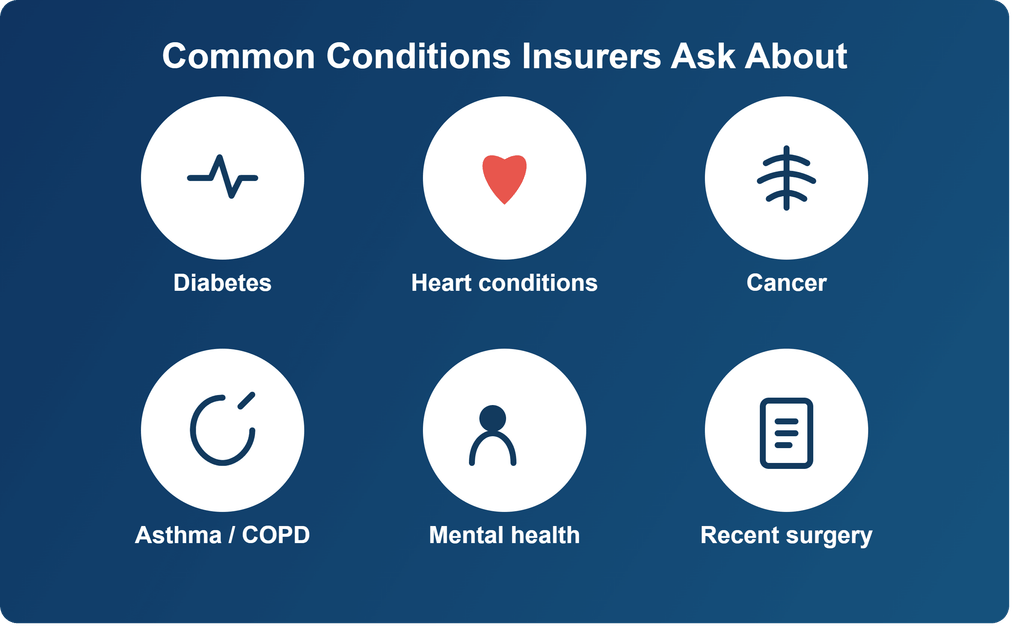
Conditions that may require disclosure can include:
- Diabetes
- Asthma
- COPD
- Heart disease
- High blood pressure
- Cancer
- Stroke
- Epilepsy
- Multiple sclerosis
- Crohn’s disease
- Arthritis
- Anxiety or depression
- Recent surgery
- Ongoing treatment
- Undiagnosed symptoms or investigations
As a result, even a condition that feels minor may need to be declared if the insurer asks about it.
Why Does Medical History Matter for Travel Insurance?
Insurers use medical information to assess the likelihood of medical treatment, cancellation or other losses during your trip.
That assessment can affect your premium, exclusions and eligibility.
The important distinction is between having a medical condition and having appropriate insurance for that condition.
Travel Insurance for Medical Conditions: What You Need to Know
Travel insurance for medical conditions is designed for travellers who have existing health concerns that may affect their trip. Conditions such as diabetes, asthma, heart disease, cancer history, or high blood pressure may require medical screening before an insurer confirms coverage.
For costs, screening and UK options in full, read our complete guide to travel insurance with medical conditions.
Having a medical condition does not always mean you cannot get travel insurance. However, you usually need to declare your conditions accurately because undeclared medical issues can affect claims and coverage.
Does Travel Insurance Cover Pre-Existing Medical Conditions?
Some travel insurance policies can cover pre-existing medical conditions, but coverage depends on the insurer and the details of your health condition. Some travellers may receive standard coverage, while others may need to pay an additional premium or choose a specialist policy.
Medical screening helps insurers understand your health situation and determine whether any exclusions or additional terms apply to your policy.
Why Medical Screening Matters for Travel Insurance
Medical screening allows insurers to assess the risk related to your health condition before providing coverage. During screening, you may need to provide information about:
- Your diagnosis
- Current medications
- Previous treatments
- Recent medical appointments
- Upcoming procedures
Completing medical screening accurately helps ensure you receive suitable coverage and reduces problems if you need to make a claim during your trip.
Best Travel Insurance for Pre-Existing Conditions
Finding the best travel insurance for pre-existing conditions depends on your medical history, age, destination and the type of coverage you need. The right policy should provide suitable medical protection while clearly explaining exclusions, screening requirements and coverage limits.
Travellers with existing medical conditions should compare policies based on medical coverage, emergency assistance, cancellation protection and whether their condition can be accepted by the insurer.
What to Look for in the Best Travel Insurance for Pre-Existing Conditions
When comparing travel insurance for pre-existing conditions, travellers should focus on more than just the premium price. A suitable policy should provide the right balance of medical protection, coverage limits and conditions that match their health situation.
Medical Coverage Limits
Check the maximum amount the policy will pay for emergency medical treatment abroad. Travellers with pre-existing conditions should pay close attention to medical expense limits because healthcare costs can be high, especially in countries like the US.
Pre-Existing Condition Acceptance
Not every insurer covers every medical condition. Check whether your condition can be accepted, whether a medical screening is required and if any exclusions apply.
Medical Screening Process
A proper medical screening process helps insurers understand your health history and determine available coverage. Always provide accurate information about diagnoses, medication and previous treatments.
Emergency Medical Assistance
Look for policies that include 24-hour emergency support so you know who to contact if you need medical help while travelling.
Cancellation and Interruption Coverage
Some policies may provide protection if a covered medical issue prevents you from starting your trip or forces you to return home early.
Medical Evacuation and Repatriation
For serious medical situations, emergency transport and returning home can become very expensive. Check whether the policy includes evacuation and repatriation benefits.
Policy Exclusions and Restrictions
Always read exclusions carefully. A policy may accept your condition but still exclude certain treatments, complications or situations.
Best Travel Insurance Features for Different Travellers
Different travellers may need different types of protection when choosing travel insurance with pre-existing conditions. The best option depends on your age, health situation, destination and the level of medical support you need.
Seniors with Pre-Existing Conditions
Older travellers may need policies with higher medical coverage limits, flexible medical screening and coverage options for age-related conditions. It is important to check whether the insurer accepts existing health conditions before purchasing a policy.
Travellers with Chronic Medical Conditions
People with conditions such as diabetes, asthma, heart disease or high blood pressure should look for insurers that consider their medical history and provide suitable coverage after screening.
Travellers Visiting the USA
Travellers visiting the United States should pay particular attention to emergency medical coverage because healthcare costs can be extremely high. Policies should be checked for medical expense limits, emergency assistance and pre-existing condition waiver requirements.
Travellers with Multiple Medical Conditions
People with several medical conditions may need specialist providers or policies with more detailed medical screening. Comparing coverage terms and exclusions is especially important in these situations.
For US travellers with pre-existing medical conditions, the best travel insurance option depends on your health history, trip details and coverage needs. The providers below are known for offering travel insurance plans that may include pre-existing condition benefits, subject to eligibility rules, medical screening requirements and policy terms.
| Travel Insurance Provider | Best For | Pre-Existing Condition Benefits | Key Coverage Features |
| Seven Corners | Travellers looking for flexible medical coverage options | Some plans may include a pre-existing condition waiver if eligibility requirements are met | Emergency medical coverage, medical evacuation, trip protection options |
| Allianz Travel Insurance | Travellers who want a well-known travel insurance provider | Selected plans may offer pre-existing condition waivers when purchase and eligibility rules are satisfied | Emergency medical expenses, trip cancellation, emergency transportation |
| IMG (International Medical Group) | International travellers needing medical-focused coverage | Certain plans may provide options related to pre-existing conditions depending on plan rules | International medical coverage, evacuation benefits, travel assistance |
| Tin Leg | Travellers comparing multiple coverage levels | Some plans may include pre-existing condition waivers when requirements are met | Medical coverage, cancellation protection, emergency assistance |
| Travel Insured International | Travellers looking for comprehensive trip protection | Eligible plans may provide pre-existing condition waiver benefits | Trip cancellation, medical coverage, evacuation and assistance services |
Pre-existing condition coverage is not automatic and varies by provider and plan. Travellers should review the policy certificate, eligibility requirements, look-back periods and waiver conditions before purchasing travel insurance.
Do You Have to Declare Every Pre-Existing Condition for Travel Insurance?
If the insurer’s application or medical screening asks about a condition, you should answer accurately and completely.
As a result, failing to disclose relevant information can create serious problems when you make a claim.
Do not assume that a condition is too minor to mention.
Instead:
- Read the insurer’s medical questions carefully.
- Check what time period the questions cover.
- Include relevant diagnoses, symptoms, treatment and medication.
- Disclose recent investigations or planned treatment when requested.
- Keep confirmation of what you disclosed.
- Read the final policy wording.
How Travel Insurance Screening Works for Pre-Existing Conditions
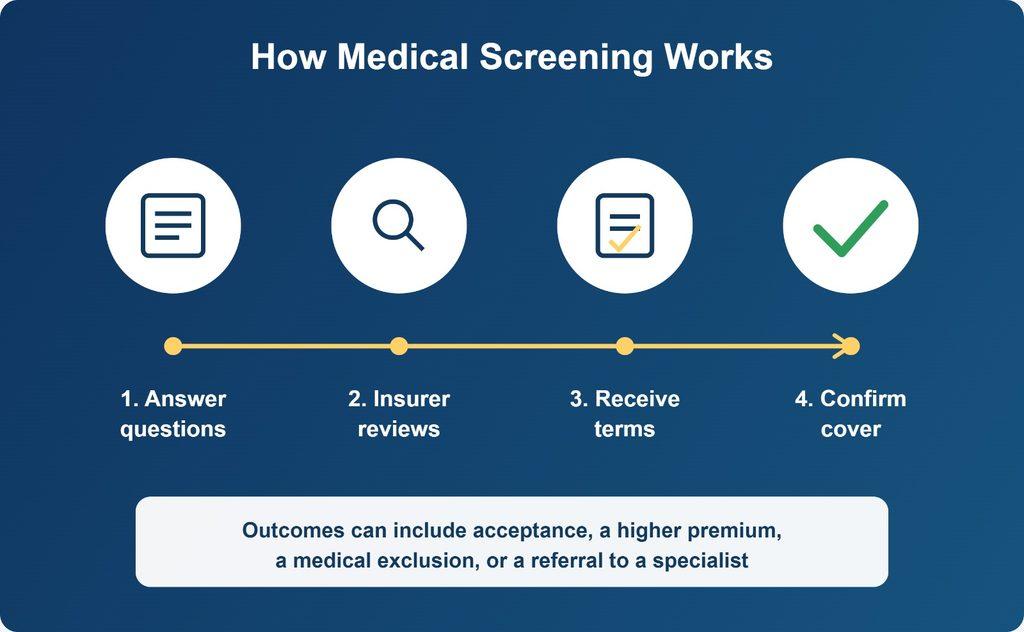
Medical screening is the process insurers use to assess your health circumstances before providing cover.
You may be asked questions about:
- Your diagnosis
- When you were diagnosed
- Recent symptoms
- Hospital admissions
- Surgery
- Medication
- Tests and investigations
- Treatment plans
- Whether your condition is stable
- Other medical conditions
The insurer then determines whether it can provide cover and under what terms.
Possible outcomes include:
| Outcome | What It Can Mean |
|---|---|
| Condition accepted | The policy may cover related medical claims |
| Higher premium | You pay more because the insurer considers the risk higher |
| Medical exclusion | Claims relating to the condition may not be covered |
| Specialist policy | You may need a specialist provider |
| Unable to provide cover | The insurer may decline the application |
Acceptance of your condition does not automatically mean every medical event connected to it is covered. Always check the policy wording.
Standard vs Specialist Travel Insurance
You do not necessarily need specialist travel insurance just because you have a medical condition.
A mainstream insurer may be suitable if your condition is stable and the insurer’s screening system accepts it.
Specialist cover becomes more important when you have complex or serious medical circumstances, recent treatment, multiple conditions or difficulty obtaining affordable cover.
| Situation | Starting Point |
|---|---|
| Stable, well-controlled condition | Mainstream insurer |
| Chronic condition requiring medication | Medical screening |
| Multiple medical conditions | Compare specialist providers |
| Recent surgery or treatment | Specialist comparison may help |
| Cancer or serious heart condition | Consider specialist insurance |
| Previous insurer declined you | Specialist provider or broker |
| Complex medical history | Specialist provider or broker |
What Does Travel Insurance for Pre-Existing Conditions Cover?
Coverage varies by policy, but suitable travel insurance can potentially protect you against several major risks.
Emergency Medical Expenses
This can cover eligible emergency treatment while you are abroad, subject to the policy’s terms, limits and exclusions.
Medical Evacuation and Repatriation
If you become seriously ill or injured and need to return home, emergency transport or repatriation can be extremely important.
Cancellation
Some policies can cover cancellation when a qualifying medical event prevents you from travelling.
Curtailment
Curtailment refers to cutting a trip short because of a covered event.
Emergency Assistance
Travel insurers may provide 24-hour emergency assistance for serious incidents abroad.
What May Not Be Covered by Travel Insurance for Pre-Existing Conditions?
Never assume that your diagnosis being accepted means unlimited cover.
Common exclusions or restrictions can involve:
- A condition that was not disclosed
- Treatment excluded by the policy
- Travelling against medical advice
- Planned or elective treatment abroad
- Certain high-risk activities
- Destinations subject to relevant travel restrictions
- Medical expenses that do not meet the policy definition of an emergency
- Conditions covered only under specific terms
- Claims exceeding policy limits
Your policy wording is more important than a provider’s general advertising statement.
How Much Does Travel Insurance for Pre-Existing Conditions Cost?
There is no reliable universal price because premiums are highly individual.
The cost can be influenced by:
- Age
- Medical condition
- Number of conditions
- Treatment history
- Stability of the condition
- Destination
- Trip duration
- Type of activities
- Coverage limits
- Excess or deductible
- Cancellation coverage
- Medical evacuation requirements
A US trip can require particularly strong medical coverage because healthcare costs can be substantial.
For a quick, personalised estimate, try our free travel insurance cost calculator.
How to Reduce the Premium on Travel Insurance for Pre-Existing Conditions
Do not automatically choose the cheapest policy.
Instead:
- Compare several providers.
- Compare specialist and mainstream options.
- Choose an appropriate excess.
- Remove unnecessary extras.
- Check whether annual cover genuinely suits your travel pattern.
- Compare medical limits, not just premiums.
- Check cancellation and repatriation protection.
- Make sure your medical condition is actually covered.
A cheap policy that excludes the medical risk you are most concerned about may provide little practical value.
Pre-Existing Condition Waiver for US Travellers
US travellers will often encounter the term pre-existing condition exclusion waiver.
A waiver can remove or reduce the policy’s normal exclusion for pre-existing medical conditions if the traveller meets the insurer’s requirements.
These requirements can vary significantly.
They may involve factors such as:
- Buying the policy within a specified time after the initial trip payment
- Insuring the full non-refundable trip cost
- Being medically fit to travel when purchasing
- Meeting the insurer’s look-back requirements
- Maintaining eligibility under the policy
This is different from the UK model, where medical screening and declaration are particularly prominent.
Do not assume that a US waiver works the same way as UK medical screening.
Always check the specific policy’s eligibility conditions before purchase.
US vs UK Travel Insurance for Pre-Existing Conditions
The two markets use different terminology and often emphasize different parts of the insurance process.
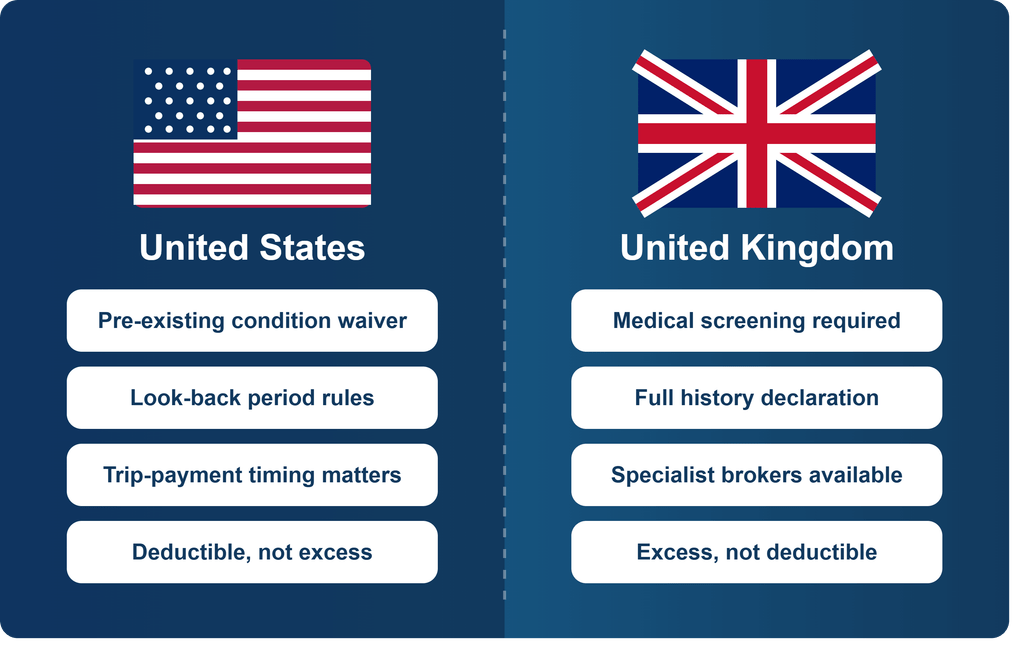
| US | UK |
|---|---|
| Pre-existing condition waiver | Medical screening |
| Look-back period | Medical history and declaration |
| Stability requirements | Medical acceptance and exclusions |
| Trip-payment timing can matter | Specialist providers are important |
| Travel medical insurance | Travel insurance |
| Deductible | Excess |
| Repatriation and evacuation | Repatriation and medical expenses |
| State-specific insurance considerations may apply | FCA-regulated insurance market |
UK Travel Insurance for Pre-Existing Conditions: What You Need to Know
UK travellers should pay particular attention to medical declaration, specialist insurance and policy exclusions.
If a mainstream comparison website does not provide suitable cover, a specialist broker can be worth considering.
For most UK travellers, your city does not fundamentally change the medical underwriting rules.
The more important factors are your insurer, medical circumstances, destination and policy terms.
Searches such as “specialist travel insurance in London” or “travel insurance broker near me” can help locate a provider, but the policy itself should be assessed based on coverage rather than location.
Is GHIC Enough, or Do You Need Travel Insurance for Pre-Existing Conditions?
No. A GHIC or eligible EHIC is not a replacement for travel insurance.
A GHIC can provide access to medically necessary state healthcare under applicable arrangements, but it does not provide the same protection as comprehensive travel insurance.
For example, GHIC and EHIC arrangements do not provide protection for costs such as private healthcare and repatriation.
If you have a pre-existing medical condition, this distinction becomes even more important.
Before travelling to Europe, check both:
- Your GHIC or EHIC eligibility
- Your travel insurance medical coverage
What If Your Health Changes After Buying Travel Insurance?
This is one of the most important parts of the insurance journey.
A new diagnosis, medication, treatment, surgery or significant change in health can affect your cover.
Do not simply assume that the policy you purchased remains unchanged.
Contact your insurer and ask whether the change needs to be disclosed or medically screened.
Also check whether the policy contains specific requirements about notifying the insurer of changes before departure.
Travel Insurance for Common Pre-Existing Conditions
For a wider overview covering many conditions at once, see our UK guide to travel insurance with medical conditions.
Diabetes
People with diabetes may be able to obtain travel insurance, but insurers may ask about medication, treatment and stability.
Compare policies carefully if you have complications or other conditions.
Cancer
Cancer can require more specialised underwriting, particularly during active treatment or after recent treatment.
A specialist provider may be more appropriate if mainstream insurers cannot offer suitable terms.
Heart Conditions
Heart disease, previous heart attacks and other cardiovascular conditions can affect premiums and eligibility.
Medical screening should be completed accurately.
If you specifically have a heart condition, see our detailed guide on how much travel insurance can cost.
Asthma
Mild, well-controlled asthma may be straightforward to insure, but it should still be disclosed if requested by the insurer.
COPD
COPD can require more detailed medical screening, particularly where there have been recent exacerbations, hospitalisation or oxygen requirements.
Mental Health Conditions
Mental health conditions can also fall within medical declaration requirements.
Check your policy carefully to understand how your condition, treatment and any related claims are handled.
High Blood Pressure
Hypertension is one of the most commonly declared conditions for travel insurance. Most insurers can cover it if it’s controlled with medication — see our full guide on travel insurance for high blood pressure for the declaration process and cost factors.
Single-Trip vs Annual Travel Insurance
Single-trip cover is built around one journey, while annual multi-trip cover can suit frequent travellers, though maximum trip lengths and medical declarations still apply. Annual cover is not automatically cheaper, so compare both using the same trip and medical details. For older travellers, see our guide to yearly travel insurance for over 75s.
What If You’re Still Under Investigation for a Condition?
If you’re still waiting for test results or a diagnosis, you’ll usually need to tell the insurer about the investigation when asked, even without a confirmed diagnosis. Some insurers will add an exclusion or decline cover until the investigation ends. For the full guide, read our article on travel insurance while under investigation.
A Simple Decision Framework for Travel Insurance with Pre-Existing Conditions
Use this as a starting point:
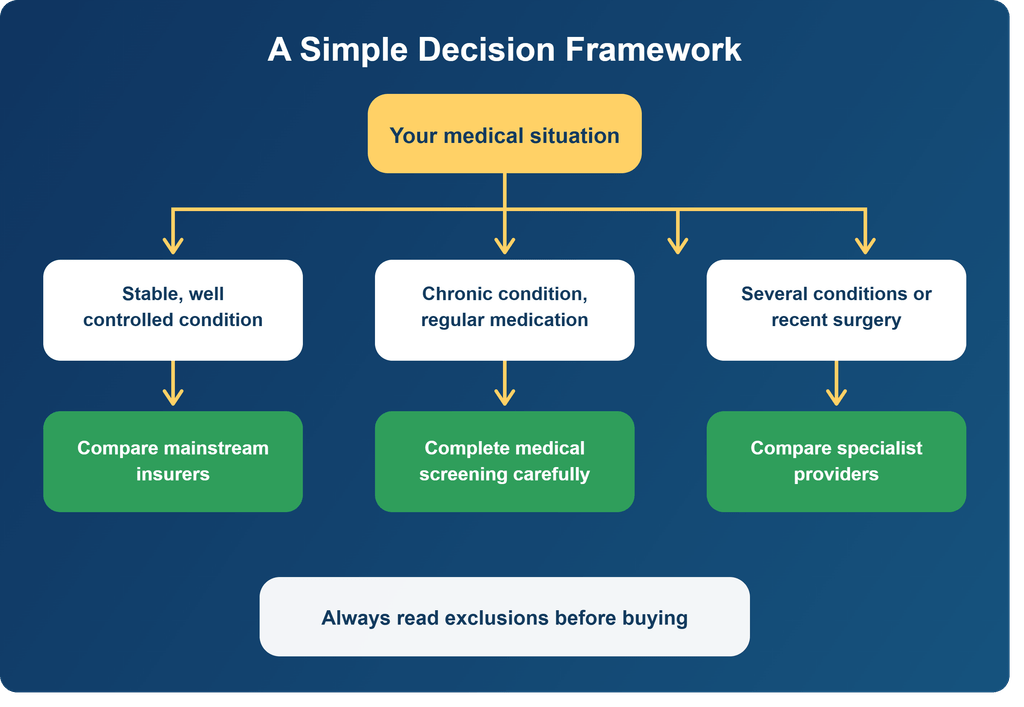
If your condition is stable and well controlled: Compare mainstream insurers.
If you take regular medication or have a chronic condition: Complete medical screening carefully.
Several medical conditions? Compare specialist providers.
If you recently had surgery or treatment: Ask insurers how the change affects cover.
If a provider declines you: Do not assume you are uninsurable. Investigate specialist providers or a broker.
Travelling to the USA? Pay particular attention to medical-expense limits, evacuation and any pre-existing condition waiver requirements.
If you are travelling from the UK to Europe: Carry your GHIC or EHIC where applicable, but still obtain appropriate travel insurance.
How to Buy Travel Insurance With a Pre-Existing Condition
Time needed: 30 minutes
Follow these steps to find suitable travel insurance for pre-existing conditions.
- Prepare your medical information.
Have your diagnoses, medications, treatment details and relevant dates available.
- Check the insurer’s definition.
Do not assume every provider uses the same definition of a pre-existing condition.
- Complete medical screening honestly.
Answer every relevant question accurately.
- Compare mainstream and specialist providers.
This is particularly important if your condition is complex.
- Compare the actual coverage.
Look at medical expenses, evacuation, repatriation, cancellation and curtailment.
- Check exclusions.
Confirm whether your condition and related complications are covered.
- Check excess or deductible.
A lower premium can sometimes come with a higher amount you must pay toward a claim.
- Read the policy wording.
Do not rely only on the summary page.
- Buy early.
Buying soon after booking can provide cancellation protection where the policy includes it.
- Update the insurer if your circumstances change.
Ask before travelling rather than discovering a problem during a claim.
Common Mistakes to Avoid When Buying Travel Insurance with Pre-Existing Conditions
Choosing the Cheapest Policy
Price should be one factor, not the deciding factor.
Assuming a GHIC Replaces Insurance
A GHIC does not provide the same protection as travel insurance.
Hiding a Medical Condition
Failing to disclose a relevant condition can create major problems if you later make a medical claim.
Ignoring Recent Symptoms
A recent consultation, investigation or treatment may be relevant to the insurer’s questions.
Comparing Premiums Without Comparing Limits
A small difference in premium means little if one policy provides substantially different medical protection.
Forgetting Evacuation and Repatriation
Emergency treatment is not the only potential expense. Getting home medically can also be extremely costly.
Buying Too Late
Delaying purchase can mean missing cancellation protection for events occurring before departure.
Pre-Travel Checklist for Travel Insurance with Pre-Existing Conditions
Before leaving home, make sure you have:
- Appropriate travel insurance
- Declared relevant medical conditions
- Completed medical screening
- Checked exclusions
- Checked emergency medical limits
- Checked evacuation and repatriation
- Checked cancellation and curtailment
- Checked excess or deductible
- Confirmed destination coverage
- Checked activity or cruise requirements
- Saved your insurer’s emergency assistance number
- Taken relevant medication and documentation
- Reviewed any changes in your health with your insurer
If age is also a factor for your trip, see our guide to travel insurance for seniors and over-75s.
How to Compare Travel Insurance for Medical Conditions
Two policies with a similar premium can offer very different medical cover, cancellation protection and exclusions. Compare the medical expenses limit, exclusions, excess and what happens if your health changes before you travel. For a full UK checklist, see our guide to travel insurance with medical conditions.
Where can you find suitable cover?
Start by comparing policies from established UK travel insurers. If mainstream insurers cannot offer suitable cover, you may find it helpful to consult a specialist provider or an insurance broker.
For additional guidance, see the FCDO’s travel insurance guidance and MoneyHelper’s guide to travel insurance with a medical condition.
Important: Policy terms vary between insurers. Always read the full policy wording and confirm any uncertainty directly with the insurer before travelling.
Frequently Asked Questions
Yes, many people with pre-existing conditions can get travel insurance. You may need medical screening or specialist insurance, and your condition can affect premiums, exclusions and available coverage.
You should declare conditions covered by the insurer’s medical questions. This can include chronic illnesses, recent treatment, medication, surgery, mental health conditions and medical investigations.
It can be. The insurer may consider your medical history, age, destination, treatment and other factors when calculating the premium. However, some declared conditions may have little or no effect on the price.
Often, yes. However, a new diagnosis can change eligibility, premium or coverage. Tell the insurer about the diagnosis and follow its medical screening process rather than assuming an existing policy automatically covers it.
If you fail to provide information the insurer requires, your claim could be rejected or your coverage could be affected. Always answer medical questions accurately and keep evidence of what you disclosed.
In the US, it is a policy provision that can remove a pre-existing-condition exclusion if you satisfy the insurer’s requirements. Eligibility can depend on factors such as purchase timing, trip payments and medical stability.
There is no universal period. Each insurer can define its own medical questions and look-back requirements. Read the screening questions carefully instead of assuming there is one standard timeframe.
Some travel insurance policies can cover medical conditions, but coverage depends on the insurer, your health history, and medical screening results. You may need to declare your conditions before travelling to ensure you have suitable protection.
Condition-Specific Questions
Yes, potentially. Diabetes does not automatically make someone uninsurable. You may need to complete medical screening and should compare policies if you have complications, recent treatment or additional medical conditions.
Potentially. Eligibility depends on your circumstances, including treatment history and current health. Specialist providers can be particularly useful when mainstream insurers cannot offer suitable terms.
For a full breakdown, see our guide on travel insurance for cancer patients
No. GHIC and EHIC can help eligible UK travellers access certain state healthcare arrangements, but they do not replace travel insurance and do not provide protection such as comprehensive repatriation cover.
Contact your insurer as soon as possible and ask whether the change needs to be declared. A new diagnosis, treatment or medication can affect the policy’s terms.
It depends on how often you travel and your circumstances. Annual insurance may be useful for frequent travellers, while single-trip insurance can be easier to tailor to one specific journey.
“Holiday insurance” and “travel insurance” are the same thing — holiday insurance is simply the term more commonly used in the UK. Both cover the same risks, including pre-existing medical conditions, and the declaration process works identically regardless of which term your provider uses.
The best travel insurance for pre-existing conditions depends on your medical history, age, destination and coverage requirements. A suitable policy should provide adequate medical coverage, accept your declared conditions and offer protection for emergencies, cancellation and medical evacuation. Travellers should compare providers carefully and check eligibility rules before purchasing a policy.
Several travel insurance providers offer plans that may include pre-existing condition benefits for eligible travellers. Coverage depends on factors such as medical history, policy purchase timing, screening requirements and the insurer’s terms and conditions.
Conclusion
Having a pre-existing medical condition does not automatically mean you have to cancel your holiday or travel without insurance.
Choosing travel insurance for pre-existing conditions carefully can save both money and stress later.
The right approach is to declare your medical circumstances accurately, complete the required screening, compare appropriate providers and read the exclusions before buying.
For UK travellers, specialist insurers and regulated brokers can be valuable when standard providers are not suitable.
For US travellers, pay particular attention to pre-existing-condition waiver requirements, look-back periods and purchase deadlines.
Most importantly, do not choose a policy based on price alone. Compare the medical-expense limit, emergency assistance, evacuation, repatriation, cancellation, exclusions and treatment of your specific condition.
If you are unsure whether a condition is covered, ask the insurer before you travel and get the answer in writing where appropriate. That small step can be far more valuable than saving a few dollars or pounds on the premium.
About the Author

Rahib Naqvi researches and writes about travel insurance for UK and international travellers, focusing on older travellers, pre-existing medical conditions and policy comparison. This website provides general educational information and does not sell insurance or provide personalised financial or medical advice. Policy terms and eligibility can change, so readers should confirm current information directly with the insurer before buying.
1 thought on “Travel Insurance for Pre-Existing Conditions | US & UK Guide”