
If you have diabetes, you can still get travel insurance for diabetics for most holidays. However, diabetes is a pre-existing medical condition, so you’ll normally need to declare it and complete medical screening so the insurer can assess your cover properly.
Having diabetes does not have to stop you from travelling. However, it does mean you need to pay closer attention to medical screening, medication, emergency medical cover and the policy exclusions.
This guide explains how travel insurance works for people with Type 1 and Type 2 diabetes, what can affect the cost, and what to check before buying.
Can You Get Travel Insurance If You Have Diabetes?
Yes. Many insurers provide travel insurance for diabetics, although the available cover and price depend on your individual circumstances.
MoneyHelper says many insurers will still provide cover when existing health conditions are declared. Insurers may ask about your condition, how it affects you, treatment and any medical equipment you need.
Your insurer may consider:
- Your type of diabetes
- Medication and treatment
- Other medical conditions
- Recent hospital treatment
- Your age
- Destination
- Length of the trip
- Type of policy you choose
Do not assume that having diabetes means you need a specialist insurer. It is worth comparing mainstream and specialist providers to see what cover is available for your circumstances.
Do You Have to Declare Diabetes for Travel Insurance?
Yes. You should follow the insurer’s medical-screening questions and declare diabetes when required.
Diabetes UK says people with diabetes should fully disclose their medical conditions when arranging travel insurance. Failing to provide relevant information can lead to a claim being rejected.
You may also need to declare other conditions.
For example, someone with diabetes may also have:
- High blood pressure
- Heart disease
- High cholesterol
- Kidney problems
- Eye problems
- Nerve problems
- Asthma or COPD
- A previous stroke
The insurer may ask about these separately.

What Happens During Medical Screening?
Medical screening helps the insurer assess the risks associated with your health.
Questions can include:
- What type of diabetes do you have?
- When were you diagnosed?
- What medication do you take?
- Do you use insulin?
- Have you recently changed treatment?
- Have you been admitted to hospital?
- Are you waiting for tests or treatment?
- Do you have any other medical conditions?
The questions vary between insurers, so answer the questions on the application carefully rather than relying on what another insurer asked.
Is Diabetes a Pre-Existing Medical Condition?
Yes. Diabetes will generally be treated as a pre-existing medical condition for travel insurance purposes.
However, insurers can have different definitions of what counts as a pre-existing condition and how far back they need to ask about your medical history.
MoneyHelper explains that insurers may ask about conditions you have seen a doctor about, received treatment for, or are waiting for tests or treatment for.
This is why you should not decide for yourself that a condition is “too minor” to mention.
Does Travel Insurance Cover Type 1 Diabetes?
Yes, Type 1 diabetes can be covered by travel insurance.
Having Type 1 diabetes does not automatically mean you cannot get suitable travel insurance. The insurer will usually need information about your treatment, medication and overall health.
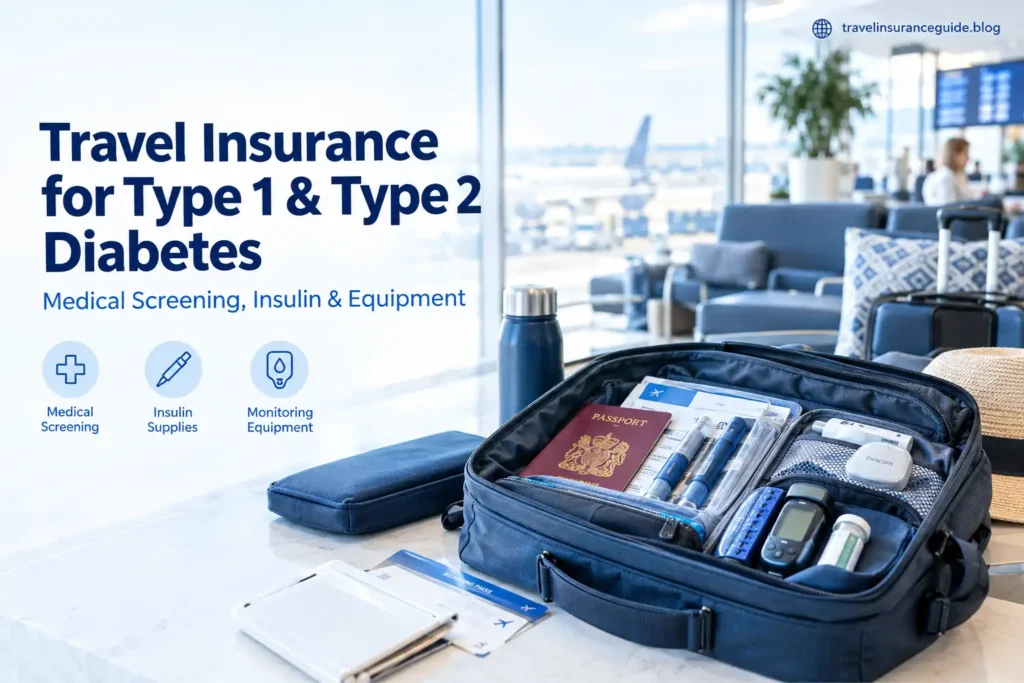
If you use insulin, an insulin pump or a continuous glucose monitor (CGM), check the policy carefully and follow the insurer’s questions about medical equipment.
Diabetes UK also recommends planning ahead when travelling with insulin, pumps or CGMs, including checking airline requirements and taking backup supplies.
Does Travel Insurance Cover Type 2 Diabetes?
Yes, people with Type 2 diabetes can also find travel insurance.
Your treatment and medical history can affect the quote. For example, someone who manages Type 2 diabetes with medication may have different insurance needs from someone who uses insulin or has other medical conditions.
The important point is that insurers assess individual circumstances. Do not assume that every policy offering “diabetes cover” will provide exactly the same protection.
Can You Get Travel Insurance If You Use Insulin?
Yes. Using insulin does not automatically prevent you from getting travel insurance.
When completing medical screening, tell the insurer about your insulin treatment if the questions require it.
You should also think about your medication and equipment before travelling. Diabetes UK recommends taking two to three times the amount of insulin, medication and equipment you would normally use, to allow for delays or unexpected changes to your trip.
If you use an insulin pump or CGM, check your airline’s requirements before flying. You may need documentation from your healthcare team.
Does Diabetes Make Travel Insurance More Expensive?
It can, but there is no standard extra cost for everyone with diabetes.
Insurers may consider your medical condition, treatment, age, destination, trip length and other health information when calculating the premium.
Other factors can include:
- Single-trip or annual cover
- Level of medical cover
- Cancellation cover
- Policy excess
- Activities during the trip
- Other pre-existing conditions
The FCA says insurers should assess medical-condition risk using reliable information relevant to the risk and should consider whether very high medical-condition premiums are appropriate.
For that reason, avoid choosing a policy simply because it gives you the cheapest initial quote.
What Does Travel Insurance for Diabetics Usually Cover?
The exact benefits of travel insurance for diabetics vary between insurers and policies.
However, suitable travel insurance may include:
| Cover | Why it matters |
|---|---|
| Emergency medical expenses | Helps with eligible medical treatment abroad |
| Repatriation | Can help with medically necessary transport back to the UK |
| Cancellation | Can cover eligible prepaid costs for covered reasons |
| Curtailment | Can help if you need to cut your trip short |
| Baggage | Can cover eligible lost, stolen or damaged belongings |
| Travel delay | May provide benefits after a qualifying delay |
| Personal liability | Can cover eligible claims involving injury or property damage |
The FCDO recommends checking that your insurance covers existing medical conditions, the full length of your trip and the activities you plan to do.
What About Diabetes Medication and Equipment?
This needs particular attention.
Check the policy wording for medication and medical equipment rather than assuming everything is automatically covered.
If you use an insulin pump, CGM or other equipment, check both your insurance terms and airline requirements.
Diabetes UK recommends carrying backup supplies and keeping important medical information with you when travelling.
Can You Get Travel Insurance With Diabetes and Other Medical Conditions?
Yes, it may be possible to cover diabetes alongside other medical conditions.
The insurer may assess your complete medical history rather than looking at diabetes on its own.
For example, a traveller could have Type 2 diabetes alongside high blood pressure and a heart condition. Each relevant condition may need to be declared during screening.
MoneyHelper says different insurers use different definitions of pre-existing medical conditions, so comparing providers can be useful if your medical circumstances are more complicated.
Do not hide another condition because you think diabetes is the only condition that matters.
Is GHIC Enough If You Have Diabetes?
No. A GHIC is not a replacement for travel insurance.
A GHIC can give eligible UK residents access to medically necessary state healthcare under the arrangements that apply in participating countries.
However, it does not provide the same protection as travel insurance.
The FCDO explains that GHIC and EHIC arrangements do not cover private healthcare, repatriation and certain other travel-related costs.
Diabetes UK also recommends travel insurance even when travelling in Europe because a GHIC or EHIC does not provide the same protection as comprehensive insurance.
Can Diabetics Get Annual Travel Insurance?
Yes, annual multi-trip travel insurance can be available to people with diabetes.
An annual policy can be useful if you expect to take several trips during the year. However, you still need to check:
- Maximum trip length
- Total travel limits
- Destination restrictions
- Medical-condition rules
- Cancellation limits
- Excess
- Exclusions
An annual policy is not automatically cheaper than buying separate single-trip policies.
If you only take one holiday, single-trip insurance may be more suitable. If you travel several times, compare the total cost and cover before choosing.

Can Diabetics Get Travel Insurance for Europe, the USA and Worldwide Trips?
Yes, but destination can affect both eligibility and price.
For Europe, check your GHIC arrangements as well as your insurance.
For the USA and other destinations where medical treatment can be expensive, pay particular attention to the emergency medical and repatriation sections of the policy.
The FCDO advises travellers to make sure their insurance covers the destination, the full length of the trip and existing health conditions.
Also check the latest FCDO travel advice before leaving the UK because travelling against government advice can affect insurance cover.
What If an Insurer Refuses to Cover Your Diabetes?
One insurer refusing cover does not necessarily mean that no suitable insurance is available.
Different insurers use different medical screening systems and risk criteria.
MoneyHelper has a Travel Insurance Directory for people who have difficulty finding cover because of a health condition. The directory lists specialist firms that are authorised and regulated by the FCA.
You can also consider using a specialist insurance broker.
Since January 2026, FCA rules require certain travel-insurance firms to give consumers information about a medical cover firm directory in situations such as refusing a quote because of a medical condition or offering certain medical-condition exclusions or premiums.
So, if a standard insurer cannot offer suitable cover, there are other routes to explore.
How Should You Choose Travel Insurance for Diabetes?
Use this simple process before buying.
Step 1: Gather Your Medical Information
Know your diabetes type, medication, treatment and other relevant medical conditions.
Step 2: Enter Your Destination and Dates
Your destination and trip length can affect the available policies and premium.
Step 3: Complete Medical Screening Honestly
Answer every question accurately.
Do not guess what the insurer wants to know or leave out a condition because you consider it minor.
Step 4: Check Medical Cover
Look at the emergency medical limit and whether your pre-existing conditions are covered.
Step 5: Check Repatriation
Make sure you understand what happens if you need medically necessary transport back to the UK.
Step 6: Check Medication and Equipment
If you use insulin, an insulin pump, CGM or other equipment, check the relevant policy terms.
Step 7: Compare Excesses and Exclusions
A low premium can come with a higher excess or restrictions that make the policy less suitable.
Step 8: Read the Policy Wording
Do this before travelling, not after something goes wrong.
How Should You Prepare for a Trip With Diabetes?
Travel insurance is only one part of your preparation.
Diabetes UK recommends taking extra medication and equipment, carrying a doctor’s letter where appropriate, checking airline requirements and having backup supplies for devices such as insulin pumps and CGMs.
Before travelling, consider:
- Taking extra medication and equipment
- Keeping essential medication in your hand luggage
- Carrying a recent prescription
- Taking your doctor’s or healthcare team’s letter if needed
- Checking airline rules
- Taking backup equipment
- Checking how insulin should be managed during long-haul travel
- Saving your insurer’s emergency contact details
- Checking the health advice for your destination
For long-haul travel across time zones, Diabetes UK recommends discussing insulin or medication adjustments with your healthcare team before the trip.
Real-World Example: A Traveller With Type 2 Diabetes
Imagine a traveller with Type 2 diabetes who takes medication and also has high blood pressure.
They are planning a two-week holiday abroad.
Rather than choosing the cheapest policy immediately, they could:
- Declare Type 2 diabetes.
- Declare their other medical condition.
- Complete medical screening.
- Check emergency medical cover.
- Check repatriation.
- Check cancellation and curtailment.
- Check medication and equipment terms.
- Compare the excess and exclusions.
- Read the policy wording before travelling.
The important point is that the policy should match the traveller’s actual health and trip, not simply advertise itself as insurance for people with diabetes.
Common Mistakes to Avoid
Not declaring diabetes
This can cause problems if you later make a claim related to your condition. Diabetes UK warns that failing to disclose relevant medical information can lead to a claim being rejected.
Forgetting other medical conditions
Your insurer may need information about conditions other than diabetes.
Choosing only by price
A cheaper policy may have different limits, exclusions or excesses.
Assuming GHIC replaces insurance
GHIC does not provide the same protection as travel insurance.
Forgetting about medication and equipment
Check what your policy says about medication, insulin and medical equipment.
Ignoring trip length
Some policies have maximum trip durations or annual limits. The FCDO specifically recommends checking these restrictions.
Buying insurance after a problem occurs
Travel insurance is designed to protect against covered future events. If you already know about a problem affecting your trip, check the insurer’s terms carefully before buying.
Questions to Ask Before Buying Diabetes Travel Insurance
Before purchasing, ask:
- Does this policy cover my diabetes?
- Have I declared all relevant medical conditions?
- Does it cover my Type 1 or Type 2 diabetes?
- Is my medication covered under the policy terms?
- What about my insulin pump or CGM?
- What is the emergency medical limit?
- Is repatriation included?
- What are the cancellation and curtailment limits?
- What excess would I pay?
- Are there diabetes-related exclusions?
- Does the policy cover my destination?
- Does it cover the full length of my trip?
- Do I need additional cover for activities or a cruise?
FAQs
Yes. Many UK insurers provide travel insurance for people with diabetes, although the available cover and price depend on your medical circumstances, destination and trip.
Yes, when the insurer’s medical screening requires it. You should answer the questions accurately and disclose relevant medical information. Failing to provide required information can affect a future claim.
Yes. Type 1 diabetes does not automatically prevent you from getting travel insurance. You may need to provide information about insulin, medication, treatment and other medical conditions.
Yes. People with Type 2 diabetes can often find travel insurance. Your treatment, medical history, destination and other health conditions can affect the policy and premium.
It can. Insurers may consider your medical condition and other risk factors when calculating the premium. There is no single price that applies to everyone with diabetes.
No. GHIC provides access to certain state healthcare arrangements but does not replace comprehensive travel insurance or cover costs such as medical repatriation.
Yes, annual multi-trip policies can be available. Check the medical conditions, maximum trip length, destinations, exclusions and annual limits before buying.
Conclusion
Travel insurance for diabetics is available in the UK, but the most important step is making sure your insurer knows about your diabetes and any other relevant medical conditions.
Whether you have Type 1 or Type 2 diabetes, comparing travel insurance for diabetics based on your health, destination and trip matters more than choosing solely on price.
Check emergency medical cover, repatriation, cancellation, medication, medical equipment, excesses and exclusions before buying.
If a standard insurer cannot provide suitable cover, MoneyHelper’s Travel Insurance Directory and specialist brokers can provide other routes to explore.
Most importantly, make sure the policy you buy matches your medical needs and your particular trip before you travel.
About the Author

Rahib Naqvi researches and writes about travel insurance for UK and international travellers, with a focus on senior cover, pre-existing medical conditions, and destination-specific policies.
4 thoughts on “Travel Insurance for Diabetics: UK Guide to Cost & Cover”