

Having a medical condition should not stop you from travelling, but it does mean you need to plan carefully before leaving home. Travel insurance with medical conditions is designed for people who have existing health issues and want protection against unexpected medical problems while abroad.
Many travellers worry:
- “Will anyone insure me?”
- “Will my medical condition be covered?”
- “Will my claim be rejected?”
- “Will insurance cost too much?”
The answer depends on your medical history, destination, age, condition stability, and the insurer’s medical screening process.
A suitable policy can provide protection for emergency medical treatment, hospital costs, medical evacuation, repatriation, and travel cancellation related to health issues.
Can You Get Travel Insurance With Medical Conditions?
Yes, many people with medical conditions can get travel insurance. Insurers usually assess your condition through medical screening, and coverage depends on your diagnosis, treatment history, destination, and policy terms.
Having a pre-existing medical condition does not automatically mean you cannot travel or cannot get insurance.
For the definition of a pre-existing condition and how US and UK waivers differ, see our guide to travel insurance for pre-existing conditions.
Many insurers provide cover for travellers with conditions such as:
- Diabetes
- Asthma
- High blood pressure
- Arthritis
- Heart conditions
- Cancer history
- COPD
- Epilepsy
- Mental health conditions
However, each insurer uses different medical underwriting rules.
What Is Travel Insurance With Medical Conditions?
It is a type of travel cover that considers your existing health conditions that considers your existing health conditions before providing protection.
Unlike standard travel insurance, which may exclude illnesses that existed before buying the policy, medical travel insurance allows insurers to assess your health situation and decide what coverage they can provide.
It may include:
- Emergency medical expenses abroad
- Hospital treatment
- Emergency assistance
- Medical evacuation
- Repatriation
- Trip cancellation due to medical reasons
For UK travellers, this type of insurance is particularly important because the NHS does not usually cover all overseas healthcare costs.
Why Travel Insurance With Medical Conditions Matters
A medical emergency abroad can become expensive quickly.
Examples include:
- Emergency hospital admission
- Ambulance transportation
- Specialist treatment
- Medical flights back home
- Unexpected medication needs
A European Health Insurance Card (EHIC) or Global Health Insurance Card (GHIC) can provide access to some state healthcare services in certain countries, but it does not replace comprehensive travel insurance.
Travel insurance provides additional protection for situations such as:
- Private medical treatment
- Emergency evacuation
- Repatriation
- Cancellation costs
- Lost travel expenses
Who Needs Travel Insurance For Medical Conditions?
This type of insurance is suitable for anyone who has an existing health condition before travelling.
Common groups include:
Travellers With Chronic Conditions
People managing long-term illnesses often need additional protection.
Examples:
- Diabetes
- Hypertension
- Asthma
- Arthritis
- COPD
Senior Travellers
Older travellers often search for:
- Travel insurance over 70 with medical conditions
- Travel insurance over 80 with medical conditions
- Senior travel insurance with medical conditions
Age alone does not prevent coverage, but insurers may perform additional medical assessments.
If you are in this age group, our guide to travel insurance for over 70s covers typical costs and how medical conditions are handled.
People With Previous Serious Illness
Some travellers need specialist policies after:
- Cancer treatment
- Heart surgery
- Major operations
A specialist insurer may be more suitable in these situations.
How Travel Insurance With Medical Conditions Works
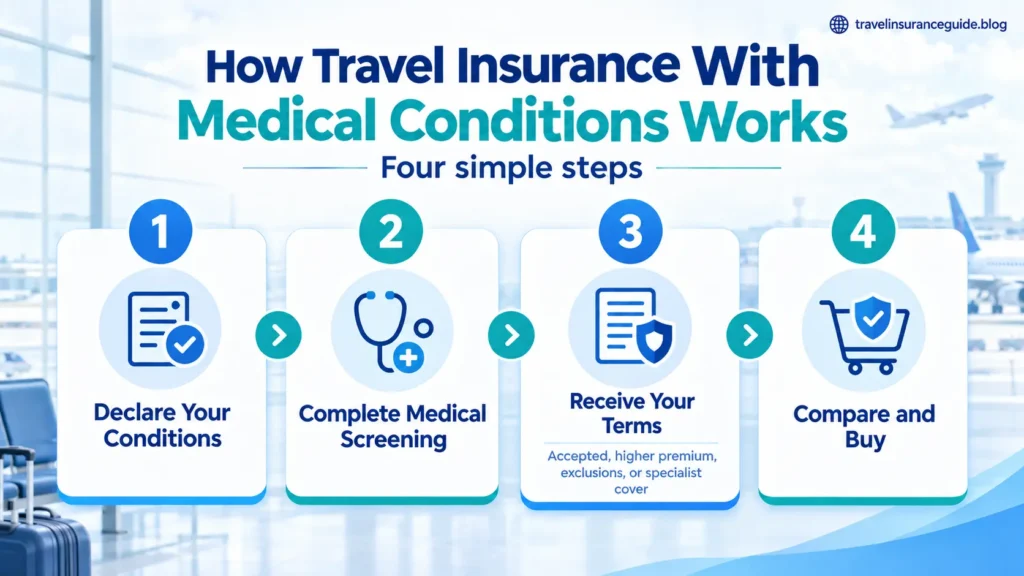
The process usually involves four steps.
Step 1: Declare Your Medical Conditions
When applying, you should provide accurate information about:
- Diagnosed conditions
- Current medication
- Previous treatments
- Hospital admissions
- Recent medical changes
For example:
“I have type 2 diabetes controlled with daily medication.”
This allows the insurer to calculate risk correctly.
Step 2: Complete Medical Screening
Medical screening helps insurers understand your situation.
They may ask:
- When were you diagnosed?
- Is your condition stable?
- What medication do you take?
- Have you recently received treatment?
- Have you had complications?
If you are waiting for tests or a diagnosis, read our guide to travel insurance while under investigation.
Step 3: Receive Your Insurance Terms
The insurer may:
Accept Your Condition
Your condition may be included in your cover.
Increase Your Premium
A higher insurance premium may apply because the insurer considers the condition a greater risk.
Add Exclusions
Some conditions or related complications may not be covered.
Decline Coverage
In some cases, a specialist provider may be required.
Step 4: Compare and Buy
Compare the terms, excess and exclusions from different insurers before you buy, then keep a copy of your policy and emergency number.
What Medical Conditions Affect Travel Insurance?
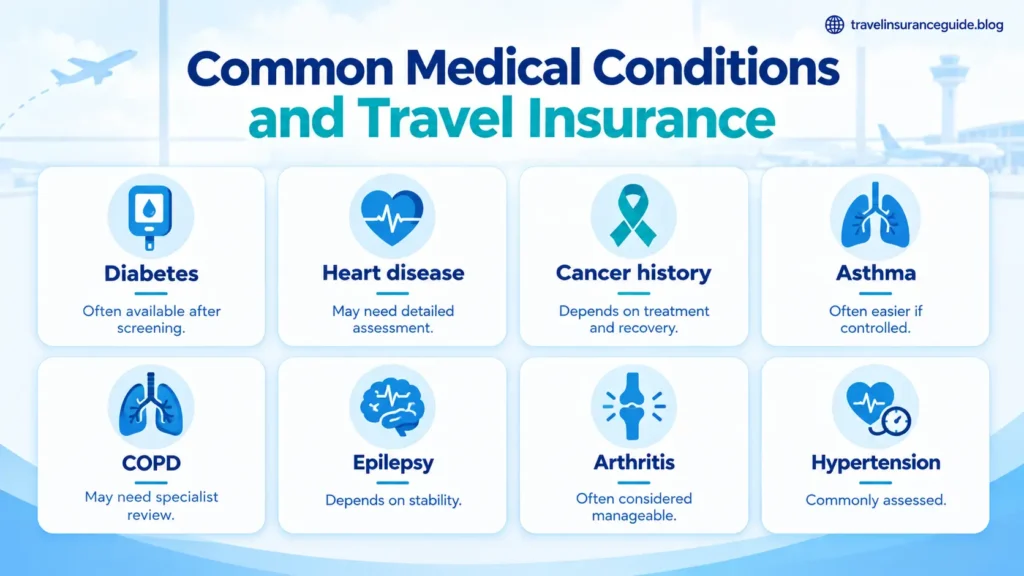
Every insurer evaluates conditions differently, but some commonly assessed medical conditions include:
| Condition | Insurance Consideration |
|---|---|
| Diabetes | Often available after screening |
| Heart disease | May require detailed assessment |
| Cancer history | Depends on treatment and recovery status |
| Asthma | Often easier if controlled |
| COPD | May require specialist review |
| Epilepsy | Depends on stability |
| Arthritis | Often considered manageable |
| Hypertension | Commonly assessed |
Hypertension is one of the most commonly declared conditions, and our guide to travel insurance for high blood pressure covers how insurers assess it.
Condition-Specific Travel Insurance Examples
Diabetes Travel Insurance
Many people with diabetes can obtain travel insurance.
Insurers may consider:
- Type of diabetes
- Medication requirements
- Complications
- Blood sugar control
Before travelling, diabetic travellers should also consider:
- Carrying medication documentation
- Keeping medicine accessible
- Understanding emergency procedures
For a closer look at costs and cover, see our guide to travel insurance for diabetics.
Heart Condition Travel Insurance
Travellers with heart conditions may need more detailed medical screening.
Factors considered include:
- Type of heart condition
- Previous surgery
- Current treatment
- Stability
Someone who had recent heart surgery may require specialist travel insurance.
For more on declaring heart problems and what affects the price, read our guide to travel insurance with a heart condition.
Travel Insurance After Cancer
Cancer survivors may still be able to obtain travel insurance.
Insurers usually consider:
- Cancer type
- Treatment completion
- Current health status
- Risk of complications
If you are currently in treatment or recovering, our guide to travel insurance for cancer patients explains screening, cost and what to ask insurers.
Specialist vs Standard Travel Insurance With Medical Conditions
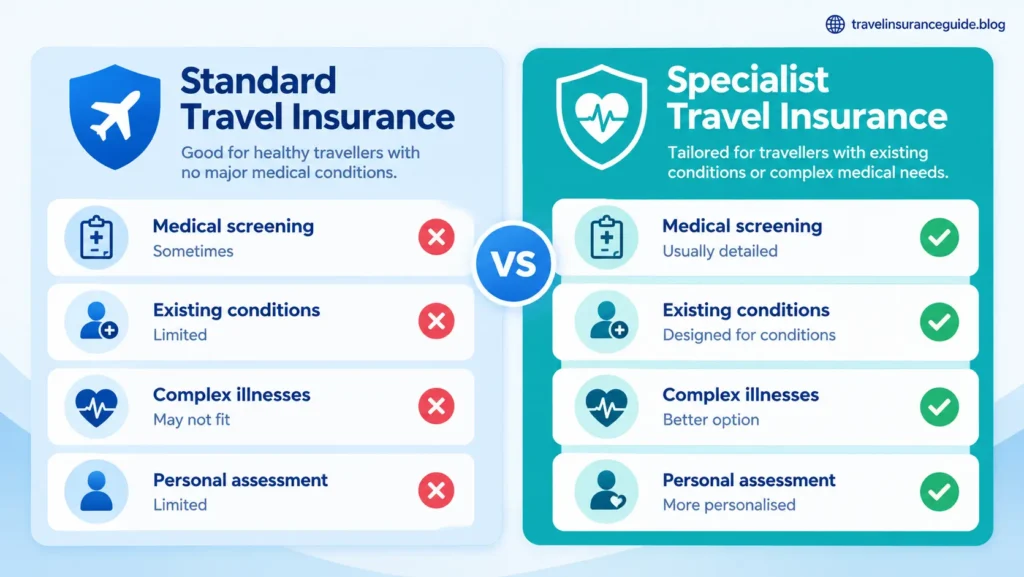
Choosing the right policy depends on your situation.
| Feature | Standard Travel Insurance | Specialist Travel Insurance |
|---|---|---|
| Medical screening | Sometimes | Usually detailed |
| Existing conditions | Limited | Designed for conditions |
| Complex illnesses | May not fit | Better option |
| Premium cost | Often lower | Usually higher |
| Personal assessment | Limited | More personalised |
How Much Does Travel Insurance With Medical Conditions Cost?
There is no fixed price because every traveller has a different risk profile.
The insurance premium depends on:
Age
Older travellers generally pay more because medical risks increase.
Medical Condition
Factors include:
- Severity
- Stability
- Treatment history
- Number of conditions
Destination
Countries with expensive healthcare systems may increase costs.
For example:
- USA
- Canada
- Switzerland
may result in higher premiums compared with some other destinations.
Trip Details
Insurance providers consider:
- Trip length
- Coverage amount
- Activities planned
- Travel destination
For a quick, personalised estimate, try our free travel insurance cost calculator.
How To Choose The Best Travel Insurance With Medical Conditions
Use this checklist before purchasing.
1. Check Medical Coverage
Confirm:
✔ Your condition is declared
✔ Emergency treatment is included
✔ Medical evacuation is covered
✔ Repatriation is included
2. Understand Policy Exclusions
Always review:
- Conditions not covered
- Treatment limits
- Excess fees
- Claim requirements
3. Compare More Than Price
The cheapest policy may not provide enough protection.
Compare:
| Factor | Importance |
|---|---|
| Medical coverage | Very High |
| Exclusions | Very High |
| Claim process | High |
| Price | Medium |
| Extra benefits | Medium |
Common Mistakes When Buying Travel Insurance With Medical Conditions
Not Declaring Medical Conditions
This is one of the biggest mistakes.
If an insurer discovers an undeclared condition after a claim, they may refuse payment.
Choosing Based Only On Price
Cheap policies may have:
- Lower medical limits
- More exclusions
- Limited emergency support
Assuming GHIC Is Enough
A GHIC card does not replace travel insurance.
It may help with certain healthcare access, but it does not usually cover:
- Private treatment
- Repatriation
- Cancellation
- Emergency transport
UK Travel Insurance Considerations
For UK travellers searching for travel insurance with medical conditions UK, important factors include:
- FCA-regulated providers
- Medical disclosure rules
- Consumer protection
- Financial Ombudsman Service support
Common UK searches include:
- Best travel insurance for medical conditions UK
- Specialist travel insurance UK
- Pre-existing condition travel insurance UK
- Travel insurance over 70 with medical conditions UK
Where to Compare Travel Insurance With Medical Conditions
Travellers often compare:
- Specialist travel insurance providers
- Insurance comparison websites
- Independent brokers
- Travel insurance marketplaces
Known insurance brands in this area include:
- Allianz
- AXA
- Staysure
- AllClear
- InsureandGo
- Post Office Travel Insurance
- Saga Travel Insurance
Always review the actual policy wording because coverage differs between providers.
Step-by-Step Buying Process
- Make a list of your medical conditions.
- Gather medication and treatment information.
- Complete medical screening honestly.
- Compare coverage limits.
- Review exclusions.
- Purchase suitable insurance.
- Save emergency contact details before travelling.
FAQs
Yes. Many insurers provide cover for travellers with pre-existing conditions after medical screening. The available coverage depends on your condition, medical history, and insurer rules.
You should declare diagnosed conditions, ongoing treatments, medication requirements, previous major illnesses, and recent medical changes.
Some policies cover declared medical conditions, while others may exclude them. Always check the policy wording before purchasing.
Yes. Many people with diabetes can obtain travel insurance. Insurers usually assess medication, stability, and any complications.
Usually, yes. Premiums may increase because insurers consider medical conditions when calculating risk.
Yes. Many insurers offer policies for older travellers, including those with existing medical conditions.
Your insurer may reject a claim if the condition was relevant to the claim and was not disclosed during application.
For travellers with complex health issues, a specialist policy may offer more suitable protection, because it is designed around individual health risks rather than a standard one-size-fits-all approach.
Conclusion
Travel insurance with medical conditions allows people with existing health issues to travel with greater confidence and financial protection.
The right policy depends on your medical history, destination, age, and travel plans. The most important steps are declaring conditions honestly, comparing coverage carefully, understanding exclusions, and choosing protection that matches your situation.
Whether you have diabetes, a heart condition, cancer history, or another chronic illness, suitable travel insurance options may be available.
Before booking your next trip, complete medical screening, review your policy details, and make sure your insurance provides the protection you need abroad.
About the Author

Rahib Naqvi researches and writes about travel insurance for UK and international travellers, focusing on older travellers, pre-existing medical conditions and policy comparison. This website provides general educational information and does not sell insurance or provide personalised financial or medical advice. Policy terms and eligibility can change, so readers should confirm current information directly with the insurer before buying.
1 thought on “Travel Insurance With Medical Conditions: UK Guide to Getting Covered”